
Protocol Vision
A blockchain you can run models on - without trusting a black box.
The Problem
A single AI provider can change a model, withdraw a dataset or stop a run without telling anyone. The answer still arrives, the interface still responds, and nothing outside that operator's own logs can show which version ran, on which data, at what cost. As AI moves into research, finance, medicine and public decisions, an unverifiable answer becomes an operational liability: you cannot audit what you cannot replay.
Verifiable AI needs provenance that cannot be edited, executions that can be replayed and compute that no single operator controls. The Ztakora Grid separates the right to publish a model from the right to certify a run. Anyone may put a model, a dataset reference or a policy on the record; the network decides, from evidence, whether that record may command hardware.
Publishing Is Open. Certification Is Earned.
Anyone can register a model, dataset reference or policy. The runtime can execute a bounded job. One Grid DAO decides whether the receipt and the evaluation evidence justify wider permissions and wider hardware scope.
- Registration is not capital: a registration needs a precise input set, a license, a cost ceiling and a reproducibility bound - not capital or political access.
- Bounded by default: every early job receives an explicit budget, hardware class, data boundary, review date and rollback path.
- Scope follows evidence: broader deployment depends on verifiability, reproducibility, usefulness, cost, safety and operability.
From Dataset To Protocol
The path from a model to a protocol action is deliberately narrow, and every stage hands the next one a record that can be inspected: what was published, what was anchored, what was executed, what it cost and what the network decided about it.
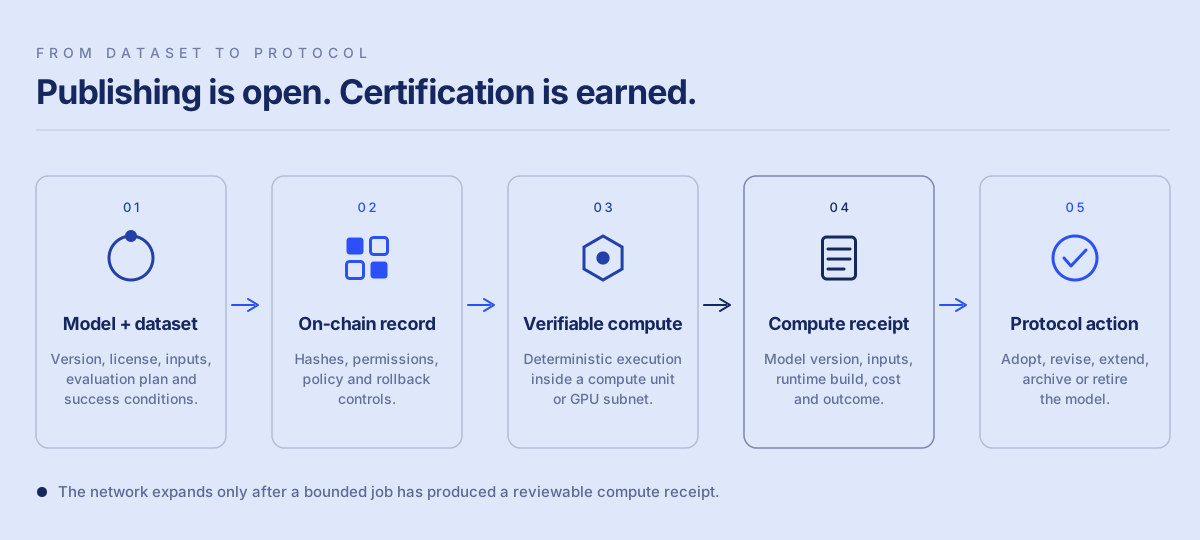
The network expands only after a bounded job has produced a reviewable compute receipt.
Six Testable Design Surfaces
The protocol is not limited to model authors or smart-contract engineers. A registration can start in any layer of the stack, as long as it is useful, bounded, measurable and reversible.
- Models: registries, versions, licenses, evaluation summaries and access policy.
- Data: datasets, weights, content addressing, licensing and provenance records.
- Compute: job definitions, hardware classes, scheduling policy and cost bounds.
- Identity: passkey identity, scoped permissions and verifiable credentials.
- Storage: permanent retrieval, encryption and policy-bound access to large files.
- Interop: cross-chain references, oracles and verifiable data feeds.
Proof Of Useful Compute
Proof of Useful Compute is not a new Layer-1 consensus mechanism. It is the protocol's verification and admission framework. Capital may fund a run, but it cannot purchase a receipt that the run was correct or useful.
- Can the run be repeated with the same inputs and reproducibility bounds?
- Does the receipt prove what was executed, on which version and how?
- Does the model solve a concrete, measurable problem?
- Is compute cost visible, bounded and sustainable at scale?
- Can abuse, data leakage and harmful outputs be detected and contained?
- Can the system be maintained, measured, paused and reversed?
Specialist councils review a domain and report into one Grid DAO. They do not create independent constitutional layers - review is not sovereignty, and each council stays bounded by design.
What Phase One Must Prove
Before the protocol claims anything larger, it has to produce one useful, verifiable compute result.
- 01 One registered model and dataset.
- 02 One controlled inference path.
- 03 One verifiable compute receipt.
- 04 Evidence-based evaluation.
- 05 A phase-one decision package.
Phase one is explicitly not a public token, permissionless GPU markets, autonomous live deployment, broad multi-model claims or financial returns. ErisAI is where these protocol ideas meet real hardware: the first compute slice tests dataset provenance, model registries, job execution and receipts on hardware that can be independently inspected.